07 October 2012

Love Conquers All

Love of printing, that is.

Jon Drew let me work on this press to do a wedding invite job! One of the reasons the book arts community is so great is that experienced printers and binders are so generous with their time in teaching young people and other learners.


This 8x12 C&P was manufactured December of 1895.


04 October 2012

{ speedy gonzales

Start to finish, an hour and 15 minutes.

I felt so speedy and on top of the world. Like when there is a tailwind and I am biking.


01 October 2012

The magic DIY 2 hour Ikea hack cheap $14 worm compost bin


At work yesterday I built this worm composting bin from 8 bricks, 3 Ikea Trofast storage bins, 1 Trofast lid, PVC pipe, caulking, and some bailing wire.

This is truly the lazy man's worm bin. The two hours includes the time it took me to go to the hardware store and buy the bailing wire. Everything else I had on hand.


I started by drawing a 1" grid on the top and middle bins (but not the bottom one) with a sharpie. If you want the sharpie to come off use rubbing alcohol on it after you drill the holes.

I drilled through the plastic with a 3/16" bit. The plastic will melt a bit ... consider ventilation.

I also drilled four holes in each of the three bins an inch from the top, then wrapped wire through them.

The bins can then be stacked on each other, and the top two switched at will.

No oxygen vents are needed for this bin.

For the spigot, I sawed off a bit of 1/2" PVC pipe and sanded the edges. Then I used a really huge drill bit to put a hole in the bottom bin (the one without holes drilled in the bottom).

Angle the pipe before using caulking to seal it. The top of the pipe can rest on the molded plastic groove that allows the bins to stack.


To start the bins, collect kitchen scraps, place in bottom of each layer and add worms. Being mailed stresses the worms out so try to find a local supplier.

In the bin, always strive for a balance of fruit, veggies, brown, and green bits, wet and dry, etc. Variety is key. The worms prefer not to subsist on "bedding" like leaves or newsprint, so if you do use it be sure to include plenty of food as well. As you generate more food scraps, just toss them onto the top layer and switch up the two layers once in a while.

Worms move from the upper levels of the bin to the lower levels, which is another reason to rotate the top two layers occasionally. If at some point most of your worms are in the bottom layer you'll have to fish them out and stick them back in the top layer.

Keep chemicals in the bins to a minimum, as the worms are sensitive to them. In our bins, we only use scraps from organic produce. We don't use newsprint as bedding (try dried leaves instead) as the paper can have acid and bleach in it. We also use rainwater (rather than the treated city tap water) in the bins.


This type of worm bin is geared toward folks who want to primarily use the worms' waste as liquid fertilizer. Put a bucket below your spigot and watch the liquid gold appear. I swear it brings dead plants back to life. It also is a miracle worker that keeps things like tomatoes (above) alive in pots in the winter. Often, yellowing leaves indicate that a plant needs the nutrients it will get from fertilizer ... with your own worm bin, you know exactly what goes into your fertilizer.

We make our compost tea with 1 part worm castings to 3 parts rain water. Use it the day you mix it up and don't let it sit overnight, or it will smell really bad.

To fertilize potted plants, we set them in a plastic bin, douse them with compost tea, and let the extra drain off. The runoff can be reused to fertilize other plants.

If you run out of castings, flush your bin with lukewarm water (too hot or cold will shock the worms) to get more.

This is a very manageable first worm bin. It is deep, holding many food scraps, but not wide, so the worms don't have to travel very far inside the bin to find food or other worms.

Happy composting!

I WANNA VISA

Not the credit card. The other kind.

Pretty please?

This weekend I went to Spanish Consulate in Chicago to apply for one.

Happily the consulate is 10 minutes from the Art Institute and 15 from the Newberry Library. It was really hard to decide which to go to so I went to both. Then I went to the Chicago Cultural Center, which used to be a library. 


Nice typography in mosaics at the Cultural Center. 

The Newberry's holdings are incredible. And there's something downright beautiful about a world class research library like that being free and open to the public. 

A highlight at the Art Institute was seeing drawings by Marion Mahony Griffin for the first time. She was one of the first female architects in the US and also a brilliant draftsman (woman?). Her drawings were influenced by her study of Japanese woodblock prints. 

Seeing her work reminded me of this recent editorial. Graves says he is "fascinated not just by what architects choose to draw but also by what they choose not to draw." Griffin's drawings have just the right amount of information.

The show included two different lithographic reproductions of her drawings on silk, which she later colored by hand with gouache.The combination of silk and gouache is perfect for renderings of prairie school architecture. The monotone paintings help you visualize the building as an extension of the landscape.

Later in her career Griffin did a series of similar silk paintings of the Australian landscape:


You can actually look at the manuscript of Griffin's autobiography, the Magic of America, online. That's where these images are from:


Griffin as a young architect.


The biggest fan of your art ...

... will always be your mom. She put your art up on the fridge before you were famous. If you're lucky she still does.


These notecards were for my mom. The white on white is elegant, but the lower case initials at an angle keep the cards from feeling too formal for everyday notes.

Jackson Pollock's mother.
Start em young!


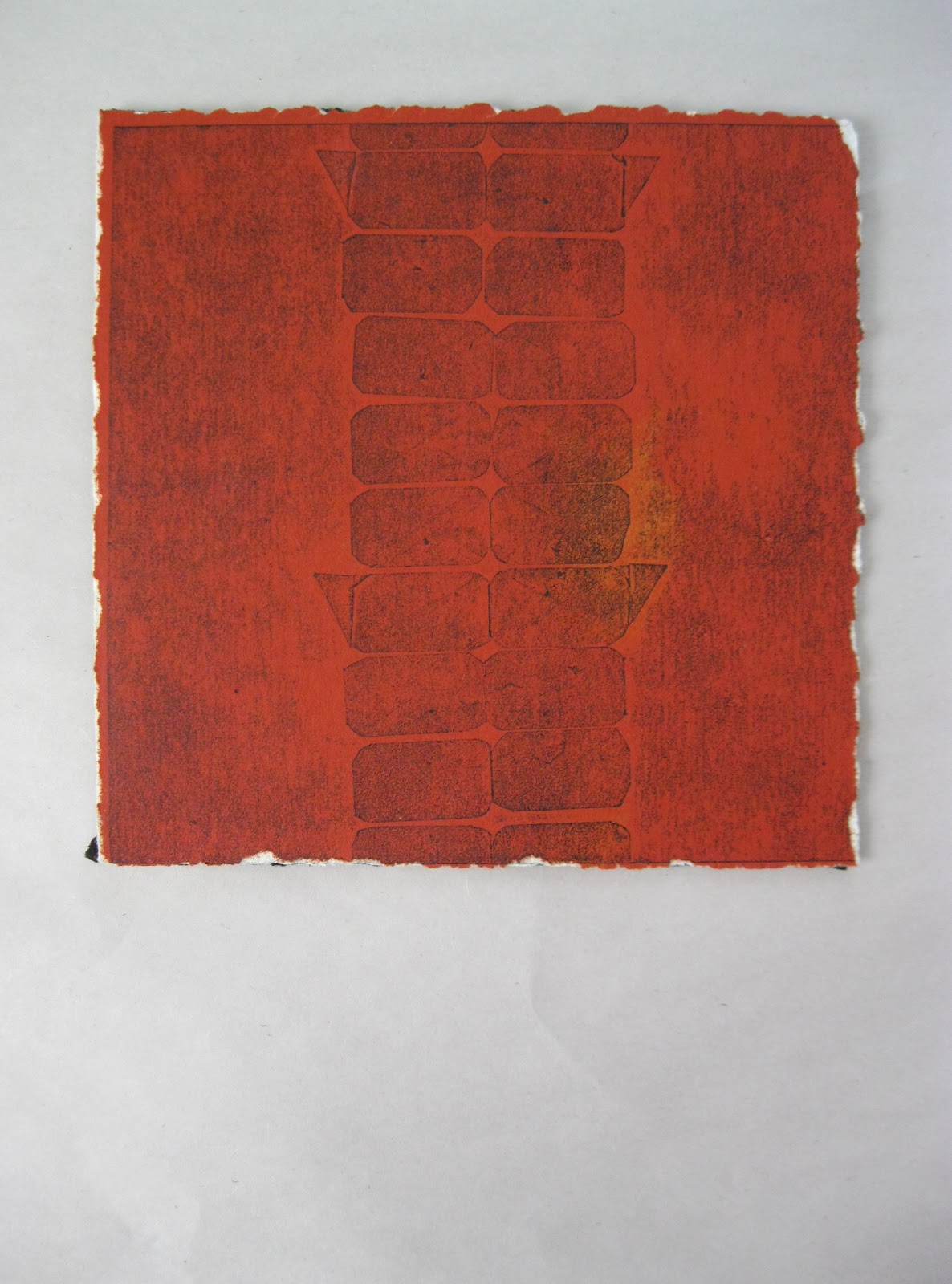
Tessellating prints!


The Roman aquaduct in Segovia is really old but it never really gets old. Sometimes I even think about it while I am not in Segovia and make prints about it.


Pressure prints.

I mixed this rich orange, with flecks of yellow, on a fiberglass slab and ran it through a combo press first with the paper (stonehenge).

Then I tore it down, to get the contrasting fake deckle, and letterpress printed a pressure plate over the top. (The plate was sticker paper attached to cardboard to make a very shallow relief. Then mounted to a boxcar base).

One of the consequences of choosing to produce an image as a print is that multiple originals are produced. Tessellating prints showcase that characteristic of printmaking.


I wanted to capture the weathered, irregular surface of the stones.

I backed the prints with two layers of black BFK. The cut paper design on the back is a puzzle.


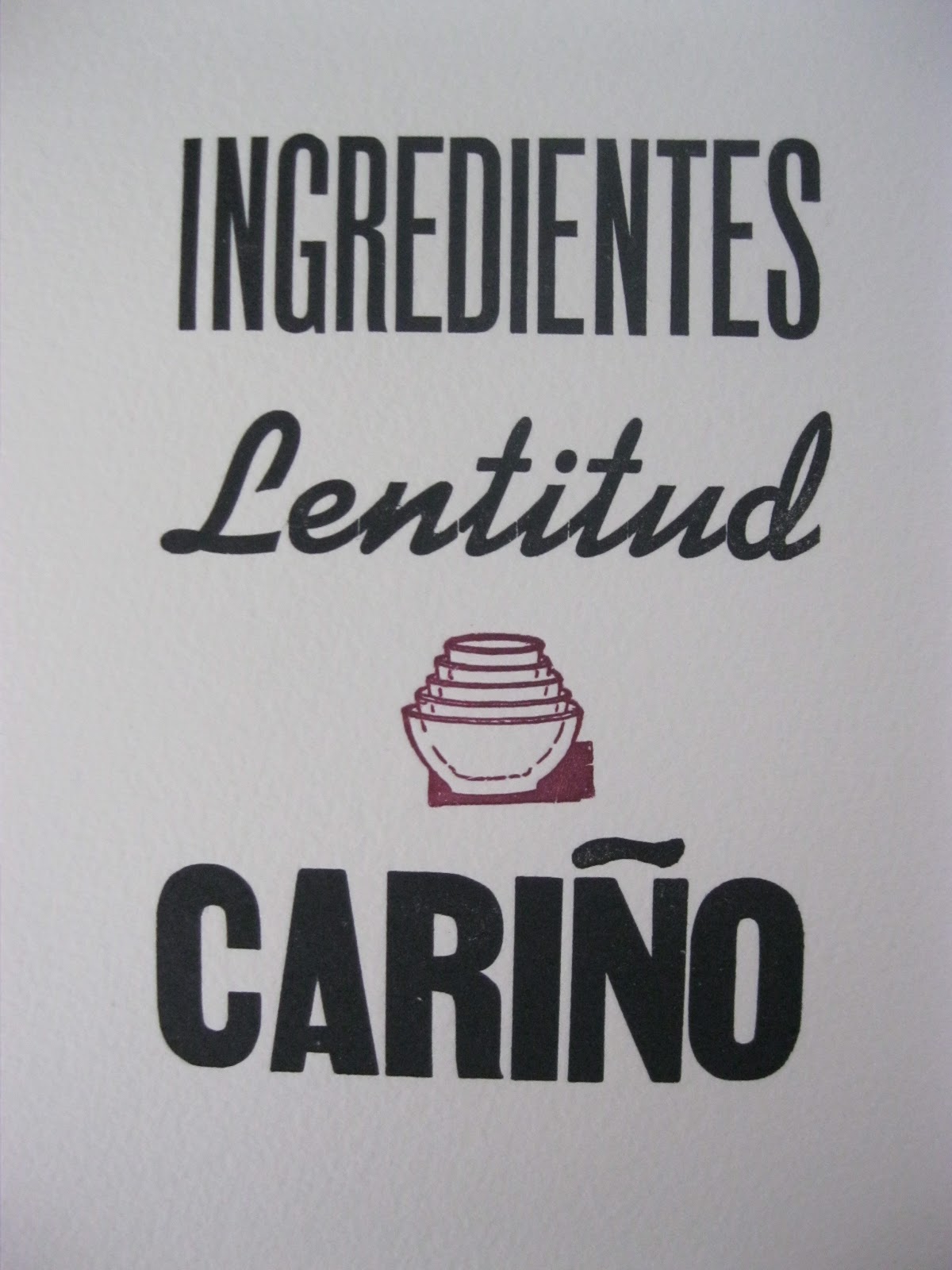
Ingredientes, lentitud & cariño

Wise words to cook by. This is a kitchen print ... a reminder to cook everything slowly, with good ingredients and, of course, love. I made it for my Spanish host mom, who told me this about cooking.

They are 5 x 7" and I printed them on some Hahnemuhle paper I found in my the stash under my bed. I damp packed the paper before printing.

The 'Ñ' is klutzy since I carved it myself; I'm so excited to be in Spain where they have REAL ones.


Is it a bird? A plane? A beehive? The cut from the studio at Leg Up is supposed to be stacking bowls.

Business cards for a flower shop


Photo credit: Satori

Paper is cream-colored Pescia, from the Wet Paint in St. Paul. The brown stock was salvaged from a friendly recycling bin.


Threaded with twine, these business cards double as enclosure cards for flower arrangements.

Love printing with a deckle.