30 January 2013

Resident. Resident in Spain.

I got a Spanish social security number today.

It was the least painful bit of paperwork I've done so far (the only complicated part is finding a job because 25% of Spain is currently unemployed). You just have to bring your ID and job contract to the social security office. Ten minutes and some small talk later, you have a SSN.

Here a SSN means you have health care. When the friendly lady at the office told me that, I was like 'I have healthcare in another country.'

And I have an apartment. And a job. And a school. And a printing press.

It's a weird feeling, folks. Right now, there aren't that many things I can do in the US that I can't do here (vote is the only one I can think of off the top of my head). I am a resident.

It's been really interesting to meet American expats who have lived here for a long time. Because, on paper it looks like I have moved across the world in a pretty big way, like I'm one of them! And I'm more documented than a lot of people I've met who plan to stay here permanently.

But I definitely don't want to be an expat -- I am American and I want to live mostly in ammerrica. And also I really like Spain and right now I am here.

What is inspiring to me is to see Catalan people move so seamlessly between cultures. Nothing about daily life being bilingual seems to faze them.

On the other hand, the newly trilingual nature of my daily life means that I have yet to have a day in three months where I don't spend a few hours feeling overwhelmed or confused about what's going on.

Today, for example, I taught an English grammar class (in Spanish). Later I hung out with an American friend (in English!!!). Then I went to my bookbinding class (in Catalan). Then I came home to an apartment full of Peruvian people who speak Spanish SO FAST. And it's Peruvian.

So I am just packing the languages and experiences in good and tight, and trying to enjoy the more crowded version of my brain. I don't think it's wrong to analyze and compare culture, but for me, now is the time to just be grateful to be in this city and try and soak it all in.


24 January 2013

Test run

Here is what I printed for my test run of the platen press we have in the bookbinding studio. The text is the is the name of my school.

I think this wood type is actually Spanish, which makes it special. There were not a lot of forests to make wood type out of in Europe, which is why wood type is very much a new world thing, but in Spain, I guess a lot of wood type was burned for fuel during the civil war. (Conjecture or fact? I'm not sure). The stuff that survives is pretty worn down (some too much to pull a decent print from it). We actually have a tool in the shop for measuring how high a piece of type is, so that we can add pieces of backing to it if it's not type high.

The metal type is Ibarra Redonda.


I need flickr

Because when I mean "write a blog post" I usually mean "post a string of photos with captions." But my mom asked me to post some more photos of my neighborhood, and how can you say no to your mother? But first, photos of this beautiful city.

Ocupa y resiste:


I think visitors must attach these to the fence at Parc Guell. I don't know why. Also it made me sad that people had carved their initials into the cacti. It's a world heritage site, leave it alone.


I wish I understood the history of the park better so I might go look up a book on it at the library. This monument did not look gaudi-ish, it was a mountain of stone with some stone crosses at the top. I met some German people there. 


This is just after sunset at Parc Puxtet. The golden building is the church on top of Tibidabo. Parc Puxtet is one of my favorite places in Barcelona.


A lot of the shops in my neighborhood have signs like this that tell you where to enter and exit. Inside, the shop is a U-shape, with the register in the middle of the U. My neighborhood, Gracia, actually used to be its own little town, but in the 1800s it was absorbed into the city. So that's why not on quite as large a scale as the other neighborhoods nearby. 


I love these windows. On a building on my way to the library.


This intrigues me so much. It's next to a boarded-up shop. WHEN DID THIS EXISIT?


Met Leo while he was painting a sign for the organic market near the metro stop. He did a really beautiful job; his blog does not even do his work justice. The word for "gilding" in Spanish is "filetes." "Filete" is also the word for "leading," in printing.


The public fountain. The sign reads, "This fountain was constructed in 1844 for the good citizens of Gracia." Today people use it to water their plants and when they're walking their dogs. But in 1844, this was probably an important spot in the neighborhood, where some people got all their water.


The main plaza, where the seat of the local government is, has this sweet clock tower. Thanks Rachel for showing it to me!


This private home is near my apartment. Sadly, my apartment does not resemble it at all. Catalan architecture is playful, decorative, organic, and eccentric. UPDATE: later I found out that this was Gaudi's first big commission. And I thought all those Japanese people with cameras had just stumbled on it, too.


A neighborhood street with light pouring in from above. Barcelona has strict building codes to make the city liveable and retain its character, so you can't build too high.


One of my favorite architectural details in buildings are terraces that have stone- or tile-work below. It's a thoughtful gesture to the street viewer.


A few snapshots of a parade in Poblenou. Reminded me so much of the Mayday parade in MPLS. 


This is what I did yesterday. These little books were made to take advantage of some paper scraps that were lying around the shop. I painted the striped paper with Noodler's Ink, which is my favorite. Coptic bindings are as old as books are. 


Setting type for some very special, bilingual business cards ... stay tuned!


15 January 2013

Japanese ... ish

These are some books I made today. I have sewn these Japanese structures before (who hasn't?) but what what different this time around was making them with a hard cover. This way the books are more substantial. But maybe a bit klunky.

Each time I make these I'm amazed at both how simple and pleasing the effect is, and how elegantly the whole thing comes together.


This is Barcelona: oranges and a blue sky

... in January! I can't get over it. (ALSO DID YOU SEE THE PALM TREES???)


13 January 2013

itsy bitsy teeny tiny ... print shop

When I was browsing through Neufville Type's 1913 catalog, I came across this little snippet -- "una imprenta minúscula."


Here's a rough translation:

"In New York City, in an unintentional gap between two buildings, what is reported to be the world's smallest print shop has recently been opened. The aforementioned gap, which measures 34 inches by 16 feet, is now home to a handsome letterpress printing shop. The proprieter pays a sum of $600 a year in rent, and the shop is sucessful, thanks to the hundreds of people who walk by it daily to make the crossing from New Jersey to New York (and vice versa). The front door is 16 inches wide, with a window display occupying the remaining 18 inches of the facade that features a 'card press' [probably a tabletop platen]. If the owner is facing the front door straight on he fills the entire width of the establishment."

08 January 2013

SEGOVIA SEGOVIA SEGOVIA

After a bit in Madrid I went "home" for Christmas to Segovia. It was the best ever. I love that place. And the people in it.

While I was there I was psyched to see a flock of sheep invade the back yard one afternoon. (That would so never happen in Barcelona). Here they are eating the neighbor's garden:


And in the roundabout.


Just look at this gorgeous pastoral landscape. Instead of running to Plaça Catalunya in the morning, I went running down those little dirt paths and said hi to the horses.


In Spain the Christmas ham is a big deal. People order one in advance, and then haul all 20+ greasy pounds of it home on busses, trains, and on foot. This shows their devotion to the ham -- they're slippery, heavy, and hard to lug around. (Imagine carrying an oily bowling ball. With a leg attached). Then the hams get mounted on "jamoneros," which secures the ham while you slowly eat it over a period of several months.

The ham is no laughing matter. Here is our ham undergoing a serious inspection:


And this is the Roman aqueduct with the Christmas lights up in the roundabout. (ROMAN AQUEDUCT). It doesn't matter how many times I see the thing, I can't get over it.


My favorite people!!! Segovians are very into going on evening walks down the Calle Real, and we did a lot of that together.


Feliz Navidad:


The Cathedral. I stepped inside for a Sunday morning mass, and to see the vestments of Bishop Juan Arias Dávila, who commissioned the first printed book in Spain.


The Ayuntamiento. It is flying the flags of Castilla y León, Spain, and the EU.


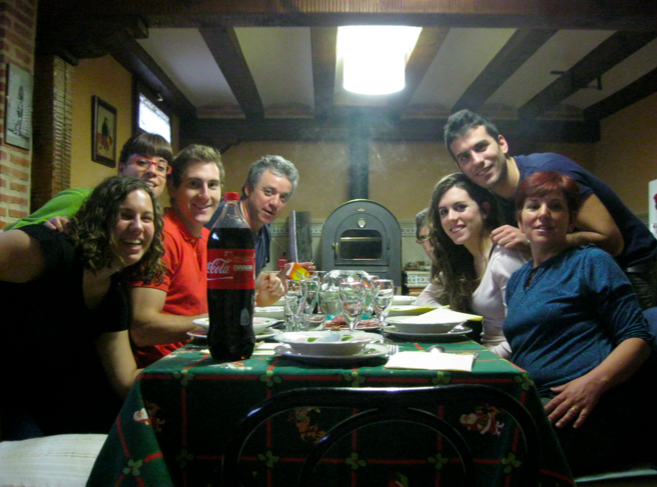
Wonderful people who adopted me for Christmas. I was so grateful and happy to spend the holidays with them. In Spain, Christmas starts on the 24th (nochebuena) with a really big meal. Then Christmas day on the 25th is just a relaxed day at home with family. On New years' eve, in Segovia, people usually have a big dinner with their families too, then go out to party. On new years' day (you guessed it) the Spanish eat a big meal and take a siesta. One really fun thing is watching the clock in the Plaza del Sol strike midnight in Madrid. On each 'campanada' you eat a grape and try to get all twelve down in time!


In Segovia it is typical to eat a roasted baby pig for Christmas. The dish is called 'cochinillo' and it's usually roasted for several hours in a 'zarzuela', a round terra cotta pan. When the piglet is done, you serve it by cutting it with a plate, to show how tender it is. If you are at a wedding (when cochinillo is also served) they might also throw the plate for good luck. :)

I'll admit that I was totally unprepared for the sight of a dead baby pig in the fridge. It just looked too much like the dissection lab in my Bio 100 class. But it is actually tasty when cooked. Maria brought up a good point: when I asked her how she could stand eating a baby pig at Christmas, she asked me how Americans could stand cutting down baby trees at Christmas.


We saw several elaborate Nativity scenes up around town. I thought they were so beautiful -- little Mediterranean landscapes filled with shepherds and Spanish tile roofs. The three wise men are a big part of the Nativity story in Spain, and Spanish sculptors who carve nativity scenes put a lot of detail into the kings.

Where's that pesky star?

At the Esteban Vicente museum I got a special tour from one of the educators. She took me to an exhibit that combined silkscreened images by Vicente with an edition of letterpress printed poems. Then she told me all about the building the museum was in (palace -> seat of the inquisition -> private home -> hospital -> art school -> abandoned ruin -> modern art museum). SPAIN IS SO OLD. 


The streets in Segovia were lively! We saw folk music, a brass band, and an a capella ensemble. The cold didn't deter the musicians at all.


This is a teeny tiny printing museum in Segovia. When I got there to take a tour (late), the museum still wasn't open. Two hours later, after I took a little walk down to the river, the museum ... still wasn't open.


 Eventually I gave up and went to a concert in a romanesque church instead. But check this out: the 17th century version of a cat door:


The concert was good and I was interested to see how they've conserved the building. I like that it continues to be used regularly by the community (unlike some of the other romanesque churches around town). 


On New years, Segovians line the streets to watch their fellow townspeople run a 5k race. We came and rooted for everyone. It's really fun because everybody runs (there's this tiny old lady who always brings up the back) and people dress up in funny costumes to run it. I saw cows, martians, santa claus, cross dressers, and the pope.


On the three kings' day, the 6th of January, the three wise men come to Spanish homes and fill the shoes of good children with gifts. This is when people give each other gifts, too. The night before, Segovia has a parade with the three wise men in it. It starts at the castle, which is all lit up for the night, and there are balloons and fireworks and a telling of the christmas story and a choir. Then the parade starts, and it's full of dancers, musicians, fire eaters, stilt walkers, and segovian children dressed up as the Kings' helpers. The kings throw candy at the crowds and take letters from the kids.


Pretty magical, huh? I will remember this Christmas forever!